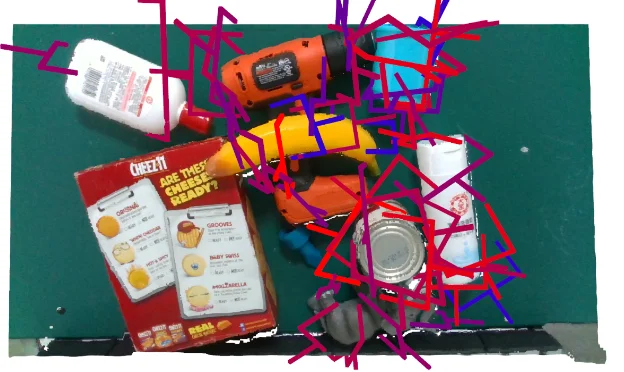
Robust 6-DoF grasp detection in unstructured environments is fundamentally plagued by ambiguity, ranging from sensor noise and diverse object scales to the intrinsic rotational symmetry of targets. Existing approaches typically treat grasp estimation as a deterministic regression or sparse classification task, often collapsing the continuous solution manifold into brittle point estimates that falter under uncertainty. In this paper, we propose ACE-Grasp, a novel framework that shifts the paradigm from deterministic fitting to uncertainty-aware distributional modeling. We first introduce a Cross-Modal Confidence Rectification (CMCR) mechanism, which leverages 2D semantic consistency to rectify unreliable 3D geometry and mitigate sensor artifacts. To resolve orientation and symmetry conflicts, we design a Dense Manifold Exploration (DME) strategy coupled with Rotational Ambiguity Modeling (RAM), replacing discrete binning with probabilistic sampling over a continuous high-resolution view manifold. Furthermore, a Dynamic Receptive Field Attention (DRFA) module is incorporated to adaptively aggregate multi-scale features, ensuring perception robustness across extreme size variations. Extensive experiments on the GraspNet-1Billion benchmark demonstrate that ACE-Grasp achieves state-of-the-art performance, outperforming existing methods by a significant margin, particularly in handling novel objects and complex geometries.
BibTeX
@inproceedings{li2026acegrasp,
title = {{ACE-Grasp}: Aleatoric Ambiguity Modeling via Consistency and Exploration for Grasping},
author = {Li, Yiming and Xie, Xianghua},
booktitle = {Pattern Recognition: 28th International Conference, ICPR 2026},
series = {Lecture Notes in Computer Science},
volume = {16821},
pages = {341--355},
year = {2026},
month = aug,
publisher = {Springer},
doi = {10.1007/978-3-032-31438-3_23},
}
Gripper Placement Matters: Bidirectional Constrained Spatial Grasp Density Field for Grasp Generation in Cluttered Scenes
IEEE International Conference on Advanced Robotics and Mechatronics (ICARM), 2026Oral
Abstract
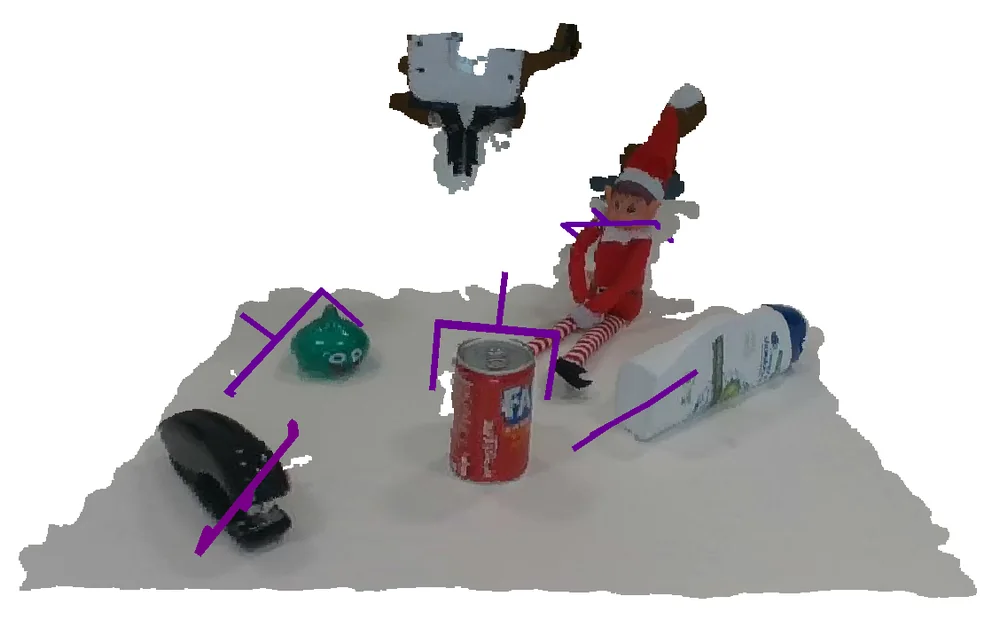
Accurate and reliable grasp pose detection is essential for effective robotic manipulation. Previous approaches typically first identify grasp points that are more likely to succeed, and predict the corresponding grasp parameters based on selected points as a way to improve performance. However, this sequential parameter prediction strategy relies heavily on the accurate localization of grasp points and is prone to error accumulation. In this work, we introduce the Spatial Grasp Density Field (SGDF), a quality based on the effectiveness of the 3D workspace for a gripper, by modeling the density of feasible landing positions in space. Building on SGDF, we design a plug-and-play bidirectional constraint module that jointly optimizes grasp point selection and gripper landing placement, yielding more robust grasp candidates. Furthermore, we develop SGDFNet, a hierarchical-alignment framework that achieves superior performance over prior state-of-the-art methods through extensive evaluation on the large-scale GraspNet-1Billion benchmark. Finally, we validate the generality of the proposed SGDF concept, demonstrating consistent performance gains in both partial and complete point cloud scenarios, showing the powerful generality of our proposed concept.
BibTeX
@inproceedings{li2026sgdf,
title = {Gripper Placement Matters: Bidirectional Constrained Spatial Grasp Density Field for Grasp Generation in Cluttered Scenes},
author = {Li, Yiming and Hu, Chen and Yang, Yue and Xie, Xianghua and Ren, Hanchi},
booktitle = {2026 IEEE International Conference on Advanced Robotics and Mechatronics (ICARM)},
year = {2026},
month = jul,
publisher = {IEEE},
}
Text-based three-dimensional geometric person retrieval
Fanzhi Jiang, Kexin Wang, Hanchi Ren, Yiming Li, Liumei Zhang, Yuanjiao Hu, Xianghua Xie, Su Yang
Engineering Applications of Artificial Intelligence, 2026
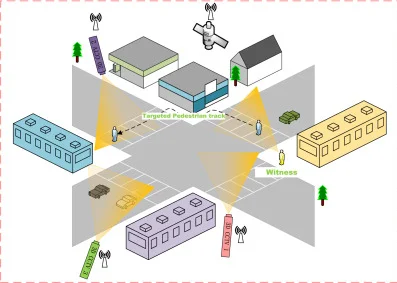
Person Re-identification (Re-ID) is crucial in computer vision, widely applied in forensic investigation, intelligent surveillance, and video retrieval. Recent text-based Re-ID methods leverage eyewitness descriptions to enhance retrieval flexibility but still face challenges in accurately characterizing individuals under complex conditions. To address issues like low resolution, viewpoint variations, and occlusions, this paper proposes a novel text-based person Re-ID approach that integrates textual descriptions with synthesized Three-dimensional (3D) geometric pedestrian data derived from existing Two-dimensional (2D) images. Specifically, the semantic richness of text compensates for the lack of color and texture details in 3D data, while the robustness of geometric and pose information significantly enhances retrieval performance. Despite current 3D pedestrian data being generated through reconstruction algorithms, this work serves as a pioneering exploration of text-to-3D pedestrian retrieval, offering substantial potential for real-world applications in multimodal biometrics, forensic investigations, and privacy protection. Experiments on three public datasets demonstrate that our method achieves competitive performance, confirming its practical applicability and significance.
BibTeX
@article{jiang2026text3d,
title = {Text-based three-dimensional geometric person retrieval},
author = {Jiang, Fanzhi and Wang, Kexin and Ren, Hanchi and Li, Yiming and Zhang, Liumei and Hu, Yuanjiao and Xie, Xianghua and Yang, Su},
journal = {Engineering Applications of Artificial Intelligence},
volume = {171},
pages = {114224},
year = {2026},
month = may,
publisher = {Elsevier},
doi = {10.1016/j.engappai.2026.114224},
}
2025
AAO-Grasp: Diffusion-Enhanced Object-Level Grasp All at Once
Yiming Li, Hanchi Ren, Yue Yang, Xianghua Xie
International Conference on Robotic Computing and Communication (RoboticCC), 2025
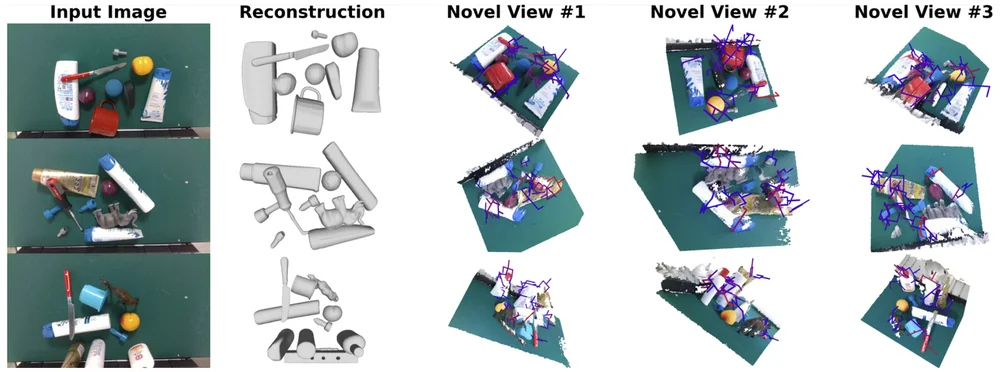
6-DoF grasping in cluttered scenes remains a challenging open problem. Most existing methods rely on RGB-D inputs or pre-defined 3D object models to extract geometric cues for grasp prediction. We propose a diffusion-enhanced 6-DoF grasp candidate generation framework that requires only a single monocular RGB image, without using any 3D priors or multi-view inputs. This enables grasp prediction from arbitrary and unseen viewpoints. Our method constructs a semantically guided diffusion-based scene template and adopts a coarse-to-fine structure to resolve scale ambiguities at both the scene and object levels. Experiments on the GraspNet-1Billion benchmark demonstrate that our approach surpasses baseline performance and achieves competitive results on novel objects, validating its effectiveness and generalization capability.
BibTeX
@inproceedings{li2025aaograsp,
title = {{AAO-Grasp}: Diffusion-Enhanced Object-Level Grasp All at Once},
author = {Li, Yiming and Ren, Hanchi and Yang, Yue and Xie, Xianghua},
booktitle = {2025 International Conference on Robotic Computing and Communication (RoboticCC)},
pages = {108--111},
year = {2025},
month = dec,
publisher = {IEEE},
doi = {10.1109/RoboticCC68732.2025.00030},
}
Recognizing Robotic Components in Complex Environment
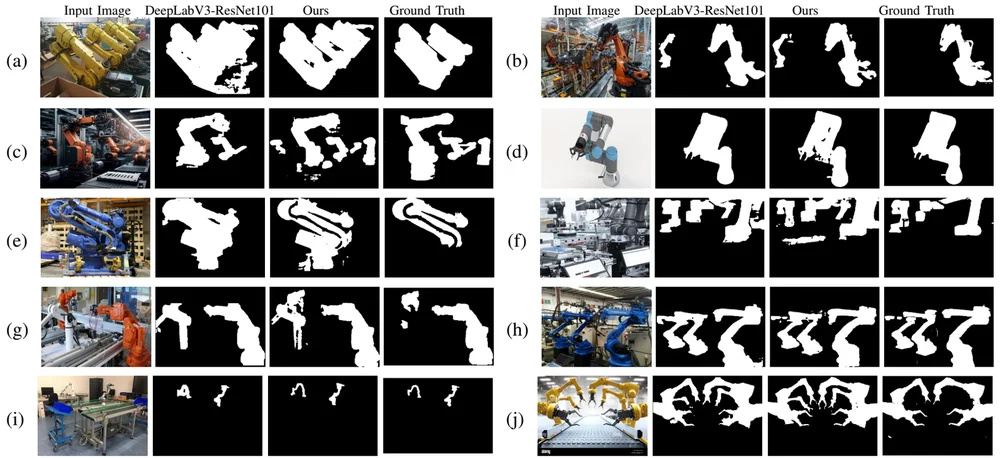
Modern robotic applications demand precise visual perception to enable intelligent interaction with dynamic environments. In complex robotic working scenarios—such as multi-arm coordination in industrial automation, collaborative robotic assistants in healthcare, and humanoid robots interacting with humans—accurate robotic arm segmentation is critical for avoiding collisions, improving motion planning, and enhancing manipulation precision. Despite its importance, this challenge has been largely overlooked in the field, with no publicly available datasets specifically designed for robotic arm segmentation. To bridge this gap, we introduce the Robotic Arm Segmentation Dataset (RASD), a manually curated dataset comprising 3,269 images covering diverse robotic arms in various environments. Additionally, we propose a novel segmentation framework that refines the output of a pre-trained segmentation model by integrating spatial and semantic information. Our method employs a Large Vision Model (LVM) to enhance spatial awareness through a textual prompt: "Where is the robotic arm in the image?". The extracted spatial and semantic features are then fused within a refined UNet, which takes an initial coarse segmentation mask as input and progressively refines it through a structured encoder-decoder process. Experimental results demonstrate that incorporating spatial-semantic fusion significantly improves segmentation accuracy compared to standard pre-trained models. By addressing a critical yet underexplored problem, our work contributes to safer and more intelligent robotic perception, paving the way for enhanced robotic autonomy in complex real-world scenarios.
BibTeX
@inproceedings{ren2025roboticcomponents,
title = {Recognizing Robotic Components in Complex Environment},
author = {Ren, Hanchi and Li, Yiming and Wang, Yunying and Guran, Nurhan Bulus and Hu, Chen and Yang, Yue and Hu, Yueyue and Hu, Junyan and Deng, Jingjing and Xie, Xianghua},
booktitle = {2025 International Conference on Robotic Computing and Communication (RoboticCC)},
pages = {92--99},
year = {2025},
month = dec,
publisher = {IEEE},
doi = {10.1109/RoboticCC68732.2025.00024},
}
Triplane Grasping: Efficient 6-DoF Grasping with Single RGB Images
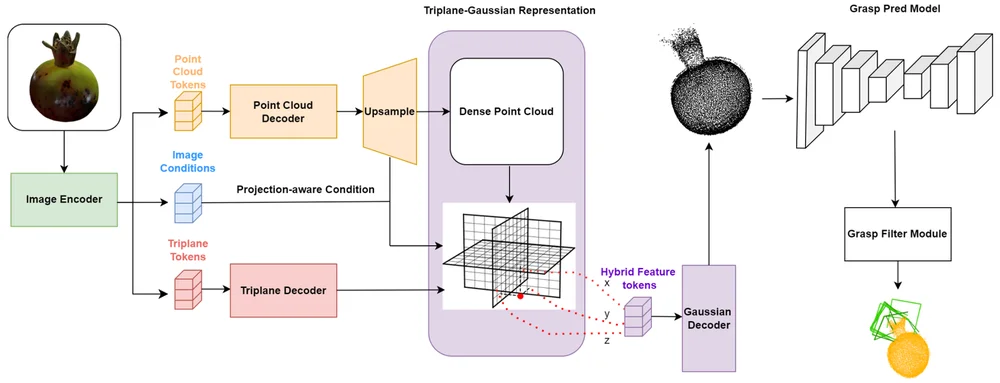
Reliable object grasping is a core challenge in robotics, yet estimating grasp poses from a single image remains difficult due to limited visual information and the complexity of real-world objects. We present Triplane Grasping, a fast and robust grasp generation framework that operates directly from a single RGB image. Our approach first reconstructs objects using a hybrid Triplane-Gaussian representation, combining an efficient point decoder with a geometry-aware triplane decoder to recover high-quality point clouds suitable for real-time manipulation. Building on this reconstruction, we generate 6-DoF parallel-jaw grasp distributions by treating each point as a candidate contact, leveraging local geometric and semantic cues while applying grasp contact filtering to ensure stable and collision-free grasps. This design anchors grasp prediction in reconstructed geometry, enabling reliable planning even for occluded or unseen object regions. Experiments on OmniObject3D and GraspNet-1Billion demonstrate that Triplane Grasping achieves fast and accurate object modeling with competitive grasp success rates, while exhibiting strong generalization to novel categories and diverse real-world scenarios.
BibTeX
@inproceedings{li2025triplane,
title = {Triplane Grasping: Efficient 6-DoF Grasping with Single RGB Images},
author = {Li, Yiming and Ren, Hanchi and Yang, Yue and Deng, Jingjing and Xie, Xianghua},
booktitle = {2025 International Conference on Advanced Robotics and Mechatronics (ICARM)},
pages = {1--7},
year = {2025},
month = aug,
publisher = {IEEE},
doi = {10.1109/ICARM65671.2025.11293550},
}
2024
Gradients Stand-in for Defending Deep Leakage in Federated Learning
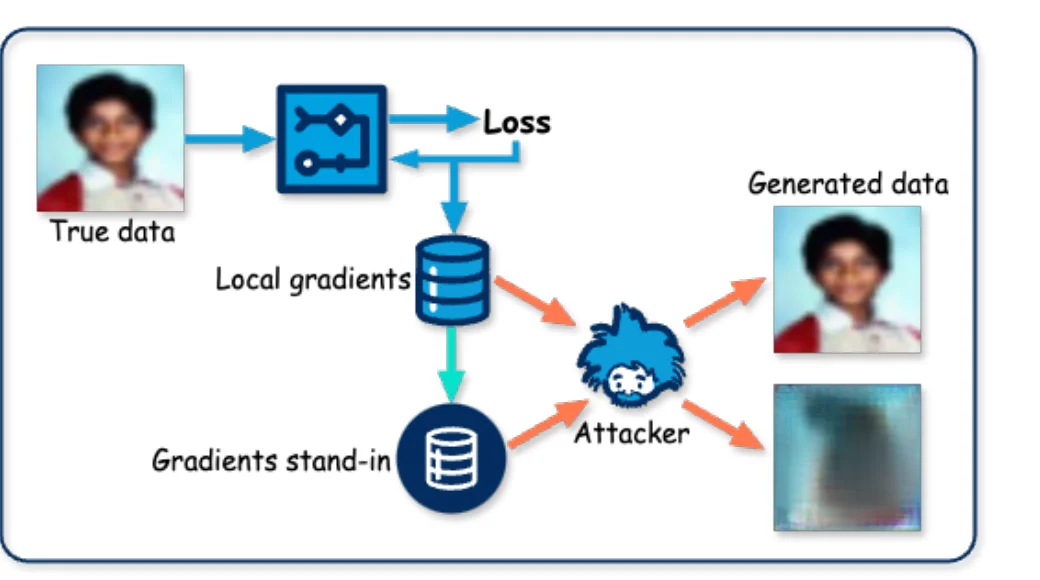
Federated Learning (FL) has become a cornerstone of privacy protection, shifting the paradigm towards localizing sensitive data while only sending model gradients to a central server. This strategy is designed to reinforce privacy protections and minimize the vulnerabilities inherent in centralized data storage systems. Despite its innovative approach, recent empirical studies have highlighted potential weaknesses in FL, notably regarding the exchange of gradients. In response, this study introduces a novel, efficacious method aimed at safeguarding against gradient leakage, namely, "AdaDefense". Following the idea that model convergence can be achieved by using different types of optimization methods, we suggest using a local stand-in rather than the actual local gradient for global gradient aggregation on the central server. This proposed approach not only effectively prevents gradient leakage, but also ensures that the overall performance of the model remains largely unaffected. Delving into the theoretical dimensions, we explore how gradients may inadvertently leak private information and present a theoretical framework supporting the efficacy of our proposed method. Extensive empirical tests, supported by popular benchmark experiments, validate that our approach maintains model integrity and is robust against gradient leakage, marking an important step in our pursuit of safe and efficient FL.
BibTeX
@inproceedings{hu2024adadefense,
title = {Gradients Stand-in for Defending Deep Leakage in Federated Learning},
author = {Hu, Yi and Ren, Hanchi and Hu, Chen and Li, Yiming and Deng, Jingjing and Xie, Xianghua},
booktitle = {2024 International Conference on Computing in Natural Sciences, Biomedicine and Engineering (COMCONF)},
pages = {53--64},
year = {2024},
month = aug,
publisher = {IEEE},
doi = {10.1109/COMCONF63340.2024.00017},
}
CenterSAM: Fully Automatic Prompt for Dense Nucleus Segmentation
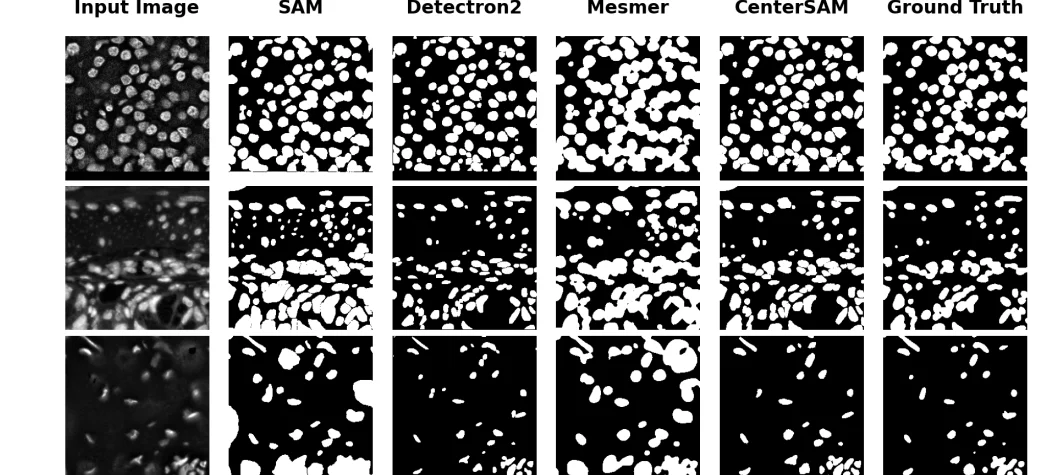
Nucleus segmentation is a vitally important task in biomedical image analysis which leads to multiple applications such as cellular behavior study, tumor detection and cancer diagnosis. However, challenges, such as ambiguous boundary for touching or overlapping nuclei often exist. This paper presents a dense nucleus segmentation method, namely CenterSAM combining the advantages from CenterNet and Segment Anything Model (SAM). It allows fully automatic prompting segmentation without prior knowledge enabling accurate and generalizable nucleus segmentation for biomedical images. Comprehensive evaluations of proposed method are performed on three nucleus segment benchmarks. The results highlight CenterSAM significantly outperforms the second best method by 5.3% on Dice Similarity Coefficient (DSC) in dense nucleus scenarios, meanwhile achieves competitive results on the sparse nucleus segmentation task. The code has been made publicly available.
BibTeX
@inproceedings{li2024centersam,
title = {{CenterSAM}: Fully Automatic Prompt for Dense Nucleus Segmentation},
author = {Li, Yiming and Ren, Hanchi and Deng, Jingjing and Ma, Xiaoke and Xie, Xianghua},
booktitle = {2024 IEEE International Symposium on Biomedical Imaging (ISBI)},
pages = {1--5},
year = {2024},
month = may,
publisher = {IEEE},
doi = {10.1109/ISBI56570.2024.10635872},
}