Research
A robot that picks from a cluttered table usually sees it from one viewpoint, yet a parallel-jaw gripper needs a complete 6-DoF pose that closes on the object without collision. My doctoral work addresses this gap in separate steps.
- Thesis
- Learning Robust and Generalizable 6-DoF Grasping in Cluttered Scenes from Visual Input
- Degree
- PhD in Computer Science, Swansea University, 2026. Passed with no corrections.
- Supervisor
- Prof. Xianghua Xie
Grasping from a single RGB image
Triplane Grasping reconstructs an object from one image with a hybrid triplane-Gaussian representation, then predicts 6-DoF grasps on the reconstruction. AAO-Grasp extends this to cluttered scenes with diffusion-guided, object-level reconstruction. It reaches 32.75 AP on GraspNet-1Billion without depth input; the depth-based GraspNet-baseline reaches 29.88 and GSNet 63.50.
Triplane Grasping, ICARM 2025, oral · AAO-Grasp, RoboticCC 2025
RoboticCC 2025 · Simulation · 0:45
Grasping from one colour photo
With a single ordinary image and no depth sensor, the robot rebuilds the hidden shape of each object and grasps it, shown side by side with a baseline that also uses depth.
Read the paperModelling ambiguity in grasp detection
Sensor noise, object scale and symmetry can leave several valid grasps for one observation. ACE-Grasp models grasp parameters as distributions: it rectifies unreliable geometry with 2D semantic consistency, samples approach directions over a dense set of views and predicts in-plane rotation as a distribution.
| AP on GraspNet-1Billion | Seen | Similar | Novel |
|---|---|---|---|
| ACE-Grasp | 73.09 | 62.82 | 26.18 |
| Best of eight compared methods | 67.12 | 58.41 | 24.59 |
RealSense split. ACE-Grasp, ICPR 2026, oral
Where a gripper can land
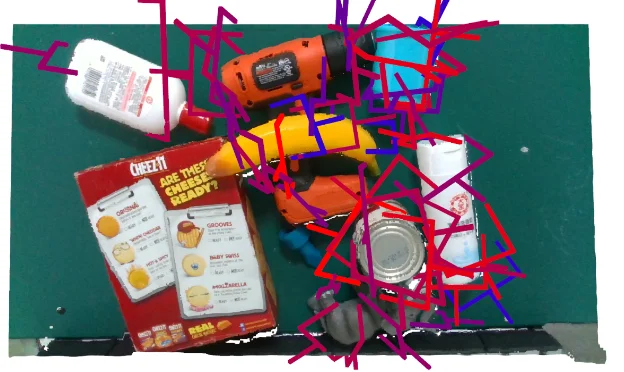
Most detectors select grasp points first, so a poor point cannot be repaired later. SGDF, the Spatial Grasp Density Field, models the density of feasible gripper placements in space and constrains point selection and placement together. On a dual-arm platform with novel objects, 50 of 75 grasps in clutter succeeded, against 37 for the GSNet baseline; on isolated objects, 43 of 60 against 35.
Gripper Placement Matters, ICARM 2026, oral
ICARM 2026, oral · Real robot · 3:00
Where should the gripper land?
A dual-arm robot clears a cluttered table. One arm looks, the other grasps. The method first works out where a gripper can physically land, then how to grasp, and succeeds more often than a strong baseline on objects it has never seen.
Read the paperWhich grasp parameter limits performance
VRCGrasp attributes failed grasps to individual prediction stages and targets the coupled approach-view and rotation estimates. Point-replacement experiments on the robot separate the effect of grasp points from that of grasp parameters. This chapter of the thesis is not yet published.
Thesis chapter, not yet published · Real robot · 0:47
Which part of a grasp fails?
Grasp points from one method and grasp parameters from another, executed on the robot, to separate where a grasp goes wrong.
Comparable evaluation
GraspPanda runs six published grasp detectors in one pipeline. Its GraspNet-1Billion evaluator matches the official graspnetAPI value for value on 1,592 recorded frames.
Earlier work
CenterSAM (ISBI 2024) prompts the Segment Anything Model automatically for dense nucleus segmentation. AdaDefense (COMCONF 2024) defends federated learning against gradient leakage.